Which natural resources are extracted in Germany?
Deep Geothermal Energy
Latest Update: November 2025
EITI Standard:
Wissenswertes
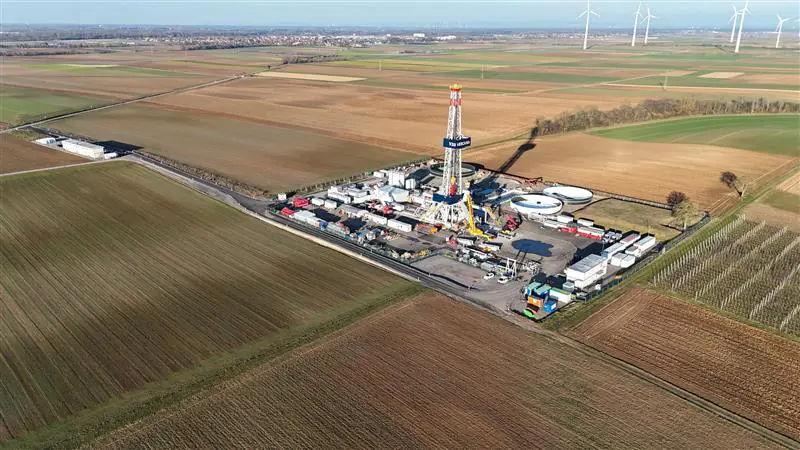
Deep geothermal energy refers to the use of geothermal heat from depths of over 400 metres and at temperatures that are typically used for heating purposes (usually above 60°C) or electricity generation (usually above 100°C). The potential in Germany is estimated at several hundred TWh,1 with great potential in the South German Molasse Basin, the Upper Rhine Graben and the North German Basin.2,3
History
The earliest example of the use of deep geothermal energy in a large-scale plant in Germany is the thermal power plant Waren at the Müritz lake in Mecklenburg-Western Pomerania, which was commissioned in 1984 and has a thermal output of 1.3 MW. Today, the regional focus of hydrothermal energy generation is the South German Molasse Basin in the greater Munich area.
Economic importance
The use of deep geothermal energy in Germany has increased over the last two decades, especially due to its growing contribution to the supply of heat via district heating networks.4 However, its share in the overall German energy mix is still low compared to other renewable energies. As of January 2025, 42 deep geothermal plants were in operation in Germany, 31 of which only produced heat and 2 only electricity.5 Gross electricity generation from deep geothermal energy was 214 GWh in 2024, which corresponds to about 0.04 % of the gross electricity consumption in Germany. The available heat amounted to 1795 GWh, corresponding to a share of about 0.2 % of final energy consumption in the heating sector.6
Although the annual heat production from deep geothermal energy in Germany is only 1.7 TWh per year (as of 2020), it can, however, be significantly increased. It is estimated that the domestic market potential is around 70 GW of installed capacity. This means that a quarter of the total heat demand in Germany can be covered by geothermal systems as well as high-temperature storage and pit water.
State funding programmes such as the Renewable Energy Sources Act (EEG) for electricity and the Federal Funding for Efficient Heating Networks (BEW) for heat create investment incentives and are intended to accelerate the expansion. The technology is considered capital-intensive with a high exploration risk, but offers stable and predictable energy production in the long term. In addition to CO₂ savings, the economic benefits of the expansion also include the regional added value and the reduction of energy imports.
Extraction
Deep geothermal energy is tapped by drilling wells to depths ranging from 400 meters to several kilometres, depending on geological conditions and temperature levels, which require a mining permit. The Geothermal Information System (GeotIS) provides nationwide information on planned and in-service facilities for the use of deep geothermal energy, as do the Bundesverband Erdöl, Erdgas und Geoenergie e.V. (including type of mining authorisation) and the Bundesverband Geothermie e.V. Every two years, the energy study of the Bundesanstalt für Geowissenschaften und Rohstoffe (BGR) provides an overview of the overall situation of geothermal energy in Germany, Europe and worldwide. The energy data is also published annually as Excel, e.g. for the year 2024. In 2022, the Federal Ministry for Economic Affairs and Energy (previously Climate Action) announced that it would initiate at least 100 additional geothermal projects by 2030, connect them to heat networks and make geothermal energy usable in residential buildings, neighbourhoods and industrial processes.7
In the hydrothermal systems, hot thermal water is extracted from water-bearing layers/aquifers. In these layers, the fluid is transported through pores, gaps or karst cavities. Above ground, the heat is extracted from the water in a power plant or a heating centre and the cooled water is returned to the subsoil. Geothermal development in Germany is currently taking place almost exclusively in the area of hydrothermal geothermal energy.
With deep geothermal probes, the water is only circulated within the borehole in the closed circuit. Due to the thermal contact with the surrounding rock, the water heats up on the way down and is brought back up via a thermally insulated pipe.8
With petrothermal systems, flow paths in the subsoil are created in hydraulically dense, in particular crystalline rock (for example granite) by generating cracks. Similar to hydrothermal systems, water is circulated through these cracks in order to obtain heat. There is great potential for this concept in Germany. Possible risks related to petrothermal systems must be examined on a site-specific basis.
Use
In Germany, the geothermal energy generated is primarily used to supply local and district heating networks in nearby municipalities or regions. Direct heating of residential areas, public buildings and commercial enterprises is the main field of application. Other applications include the provision of process heat for industry or use in balneology. The focus of the current expansion strategy is clearly on providing heat as a contribution to decarbonising the heating sector. Until now, electricity generation in geothermal power plants has played a minor role in Germany and is of particular interest where higher temperatures (>100-120°C) are available.
Furthermore, deep geothermal waters are often enriched with lithium. The additional extraction of lithium from these waters could make the use of deep geothermal energy more economical in the future, especially in the Upper Rhine Graben and the North German Basin, and thus further accelerate its expansion (see also Supply Security). However, despite existing pilot projects, there is still a considerable need for research in this area.9
Sources
1 Strategy paper of six institutions of the Fraunhofer-Gesellschaft and the Helmholtz Association (2022): Roadmap Deep geothermal energy for Germany. Recommendations for action for politics, business, and science for a successful heat transition
2 Geothermal information system. Current research data on the potential and use of geothermal energy: Overview maps
3 acatech (German Academy of Engineering Sciences) (2024): The heat transition is taking place: According to an acatech study, geothermal energy can fuel district heating
4 Geothermal information system. Current research data on the potential and use of geothermal energy: Statistics on geothermal energy
5 Bundesverband Geothermie (Federal Association of Geothermal Energy) (2025): Geothermal energy in figures. Deep geothermal energy in Germany (as of January 2025)
6 Office of the Working Group on Renewable Energy Sources Statistics (AGEE-Stat) at the Federal Environment Agency (2025): Renewable energy sources in Germany. Data on the development in 2024
7 Federal Ministry for Economic Affairs and Energy (BMWE) (2022): Geothermal energy for the heat transition – Federal Ministry for Economic Affairs launches consultation process
8 German Federal Environment Agency (2015): Deep geothermal energy – possible environmental effects due to hydraulic and chemical stimulation
9 Bundesverband Geothermie e.V. (2030): State of research and research needs for geothermal energy